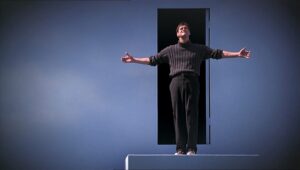
The Truman Show and reality perception lead us to a question that is both uncomfortable and useful: How do I know what I think I know? Holding a belief for years does not automatically make it true. An explanation can feel reassuring while also limiting the questions we are willing to ask. The film makes these difficulties tangible by following a person whose understanding of his own life has been carefully managed.
Here, a “mental dome” is a metaphor for assumptions we have accepted without examining them. It is not a physical structure, a measurable brain region, or evidence that our world is surrounded by a concealed apparatus. Keeping a cinematic image separate from a claim about the outside world allows a more productive discussion. We can investigate how we reach our judgments without turning a fictional story into proof of a conspiracy.
What is The Truman Show about?
In the 1998 film The Truman Show, Truman Burbank grows up without knowing that his life is a television production. Seahaven, the place he calls home, is a vast studio. His relationships and everyday experiences unfold inside a story presented to an audience. Paramount’s official film page provides a starting point for the production. The fictional premise does not establish that our own lives are organized in the same way.
My philosophical reading places knowledge and consent at the center of the story. A comfortable environment is not enough if its comfort depends on concealing alternatives and arranging another person’s choices. We can ask whether someone who claims to know what is best for us has the right to decide which truths we may encounter. This question belongs to ethics; it does not require us to believe that our surroundings are secretly a television set.
Plato’s cave: The distance between appearance and knowledge
In Book VII of The Republic, Plato describes people who can see only shadows on a cave wall and mistake those appearances for the whole of reality. The allegory of the cave offers a philosophical account of education and the movement beyond familiar appearances. It is not experimental evidence that everyone in contemporary society is being deceived.
The comparison with Truman is an interpretation: both stories invite us to examine the limits of a person’s available perspective. They are not identical accounts of knowledge. In ordinary life, a narrow social circle can also make a few opinions seem universal. Rather than assuming there must be a single hidden controller, we can ask which sources we encounter, which perspectives are absent, and what would give us a broader basis for judgment.
Useful doubt needs a method
Questioning a claim can improve our understanding when it leads to a clearer test. Rejecting every explanation in advance and embracing one enormous hidden scenario can instead replace an old certainty with a new one. The stronger a claim is, the more clearly its reasons should be set out. Emotional music, confident delivery and a dramatic storyline can make an argument memorable, but they cannot substitute for evidence.
Consider the difference between “This headline misrepresents the report” and “All news is written by one secret organization.” The first claim can be examined by comparing a headline with the report and its data. The second requires a much wider body of evidence. Productive skepticism does not treat every claim as equally doubtful. It adjusts confidence to the quality and extent of what can actually be checked.
Confirmation bias: Testing an explanation we like
In his 1960 study of hypothesis testing, P. C. Wason found that participants could seek confirming examples while neglecting tests that might undermine their hypotheses. The study reminds us to look for counterexamples. It does not show that everybody behaves identically in every situation, or that we are incapable of improving our reasoning.
Imagine someone thinking, “Nobody takes me seriously.” A delayed message may feel like evidence for that belief. Being asked for an opinion at work, or being listened to carefully by a friend, also belongs in the assessment. The point is not to dismiss the person’s hurt. It is to examine that hurt separately from a sweeping judgment about every relationship. Our article on metacognition develops this practice of looking at how we think.
Media and algorithms: A feed is not the whole world
Meta’s Instagram Feed ranking explanation describes ordering content through predictions about interest and engagement. A feed is therefore not a random sample of the world. This does not mean that everybody sees the same material or that one algorithm determines all our thoughts. It does give us a reason to distinguish the frequency of an item on a screen from its prevalence outside that screen.
Someone who watches a succession of relationship-conflict videos might begin to feel that every relationship follows the same pattern. Watching another dozen similar clips will not necessarily test that impression. Looking at independent information, asking where a claim’s evidence comes from and noticing counterexamples in daily life can offer a more useful starting point. Repetition should prompt a question about selection, not automatically become a conclusion about reality.
Autonomy: Having a say in your own life
Ryan and Deci’s account of self-determination theory discusses autonomy, competence and relatedness. Autonomy concerns acting with a sense of volition; it does not require living without other people. Connecting this framework with the film is an interpretation, not a clinical assessment of a fictional character.
We can welcome advice and still make a decision ourselves. The difficulty arises when help removes our opportunity to consider alternatives, refuse a proposal or express what matters to us. For example, family support can be useful when choosing an educational path. Having every option ruled out on our behalf without being asked what we want is a different arrangement. The film provides a setting in which to think through that distinction.
Using the mental-dome metaphor in everyday life
Examining a belief does not require a dramatic awakening. Choose a sentence you recently treated as certain: “I cannot do this,” “Everybody is like that,” or “This always happens to me.” Write down the observations behind it. Then identify the circumstances in which the sentence would need to change. This is a reasoning exercise, not a demand to replace difficult feelings with limitless optimism.
Next, consider a small, reversible way to gather information. You might ask about a course, prepare an application or request specific feedback from someone you trust. Record what you learn instead of judging the outcome only as success or failure. An unsuccessful application may tell you about a requirement you can work on; it need not settle every question about your ability or your future.
It also helps to distinguish an actual obstacle from an assumed one. Lack of time, money or access can be real constraints. A belief that no effort could ever change anything is a separate proposition. Examining the second does not erase the first. A fair account of agency leaves room for social conditions, help from others and the limits of what one person can accomplish.
A metaphor is most useful when it makes a question more precise. If it leads us to see every coincidence as a clue to a hidden story, it may obscure rather than clarify. Our article on apophenia and meaning offers a related discussion of the difference between finding a pattern and establishing what it means.
Frequently asked questions
Is The Truman Show a documentary about a real case?
No. This article uses a fictional film to explore philosophical and psychological questions. Parallels with ordinary life do not demonstrate that all the mechanisms in the story exist outside it.
Is a mental dome a scientific term?
It is a metaphor in this discussion. Hypothesis testing, autonomy and content ranking are considered separately, with links to their sources. The metaphor should not be treated as a research finding.
Can questioning my beliefs remove real problems?
Not by itself. Material conditions, working arrangements and other people’s behavior need concrete assessment. Examining our reasoning can support a more informed decision within those conditions.
Sources and further reading
Paramount Pictures. The Truman Show — film source.
Plato. The Republic, Book VII — primary philosophical text, translated by Benjamin Jowett.
Wason, P. C. (1960). On the Failure to Eliminate Hypotheses in a Conceptual Task. Quarterly Journal of Experimental Psychology, 12(3), 129–140.
Ryan, R. M., & Deci, E. L. (2000). Self-Determination Theory and the Facilitation of Intrinsic Motivation, Social Development, and Well-Being. American Psychologist, 55(1), 68–78.
Meta. Instagram Feed Ranking System Card — the platform’s technical explanation.
This is an interpretation of a film. Research findings are linked to their sources; the everyday examples were created to illustrate the questions under discussion.