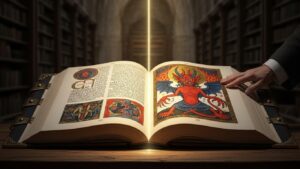
 You might have come across the name Codex Gigas, right?
These days, we keep hearing the same set of lines repeatedly: Black magic is involved.
Everyone who has had the misfortune to hold the book met with calamity.
Pages have been hidden by the authorities of the church. Secret knowledge that cannot be accessed, etc.
Honestly, I think this book is not the devil’s book. However, it demonstrates quite well how some brains operate when they want to scare people.
Basically, that is all there is.
The black magic manual they are talking about does not exist. It is just a concept people hold.
The truth is this:
The things in Codex Gigas are not strange or unusual:
holy scriptures, historical accounts, medical pieces, prayers, chronicles…
Simply, it is not a handbook of black magic.
But the human brain is not satisfied with leaving things as they are.
So the tale goes like this:
* It is impossible for a book this large to be a normal one.
* There has to be a dark side to it.
* No one single human could have written it, hence the devil must have contributed.
What is commented here with a great deal of irony is:
the monk promises to write a huge book in one night to avoid his punishment, in the case that he cannot possibly do it in time, the story that he got help from the devil to write it comes up.
He actually relocates the matter to a supernatural intervention and thereby gets himself off the hook.
And, we people, are still following that trail centuries later.
It may have been like this in reality:
you write in big letters, you decorate your pages with drawings, and after a sufficient amount of years the book turns out to be completed.
However, that version is not nearly as interesting.
Anyone Who Touched It Was Cursed The Classic Fear Slogan
The claim that everyone who touched the book was cursed should not surprise people much.
It essentially has the same format as:
* If you wear this talisman, good luck will be yours.
* If you bring this thing home, your life will be full of disasters.
* Those who carry this symbol either become very successful or end up being destroyed.
The structure is identical, only the elements are different.
When something positive takes place:
the story goes that the object was the source of power.
When something negative takes place: The story goes that the curse was set off.
All other cases are quietly being overlooked.
Philosophically, the scene is this: Amind that is incapable of or refuses to provide an explanation for
events places the blame on an object.
In this manner, it does not have to confront its own decisions, patterns, and psychology.
Fear in this instance ceases to be an emotion and becomes a sort of
comfort zone.
The expression I am cursed makes it easier to say than this is a mixture of decisions, chances, and my own psychological state.
Fear Is the Best Selling Product of Every Era
Codex Gigas is merely an example.
While the packaging changes from one era to another, the product remains the same: Fear.
Today we have these as our show cases:
* Alien conspiracies
* Mysterious deaths in the mountains
* Dark regions of the galaxy
* Tunnels under the earth
* Lost cities under the sea
* Doomsday viruses trapped in the ice
The play is always identical:
1. Choose an area that is unknown or difficult to be explained.
2. Embellish it with mystery, curse, secrecy, and chosen ones rhetoric.
3. Engage both the curiosity and the fear of the audience.
4. Imply that one has special access to this knowledge.
5. Make money through books, videos, retreats, courses, camps.
Back then, a story about a book written by the devil was a great seller.
Now, governments negotiating with aliens is the one that gets the job done.
However, the very same mechanism is always at work:
Don’t reveal the secret but give people fear to consume it instead of knowledge.
Not the Supernatural the Way We Believe
The central problem is not the existence of a supernatural being or phenomenon.
The central question is that of:
How much influence do you let your personal way of believing have over you?
The brain functions similarly if you work on the belief that you will
get something to achieve or that you will destroy yourself by believing that way.
In case you make a decision that a book is cursed, you interpret every disaster as a confirmation of that belief.
In case you make a decision that a symbol is your guard, you take every good thing and attribute it to that symbol.
In fact, you are reprogramming your own mind without realizing it.
The terms placebo and nocebo are peer to this phenomena.
The giant bible is not remotely associated with any black magical arts.
However, the people have this very strong habit in their minds: The habit of profiling things, stories, and symbols for their power rather than looking deeply into their own mind.
Codex Gigas: An Inflated Ordinary Book
Seeing Codex Gigas from a philosophical point of view, my conclusions are the following:
* Historically interesting? Surely.
* Quite a challenge to make? Definitely.
* The book has a devil drawing? Yes.
* Will that make it supernatural? No.
The real irony is that: This book has for long been referred to as
the source of all kinds of evil, a secret container of occult layers, a multi dimensional mystical artifact.
So, what do we have?
An average manuscript which is covered with labels referring to fear.
Cursed, hidden, forbidden, suppressed…
The words do not in fact make the book better, they only help to inflate the egos and the number of people who Like to Communicate through Fear,
talking that way.
Focus Not on the Fear Seller, but on the Questioner
For me, it is not the main problem that Codex Gigas is what it is.
The problem is that once again, Codex Gigas is revealing to us that this is something extremely old:
In the times when humans forget to use their brains,
they still remain able to buy fear the same thing again and again.
Nowadays it could be represented by one a cult leader, a conspiracy guru, a secret-teachings coach, an alleged expert on cursed objects or magical symbols.
What is common for them is that:
* They envelop the unknown in fear
* Characterize questioning as something dangerous or that it is not allowed
* They turn off the reason and say: just trust us
Therefore, to me Codex Gigas is not the devil’s book.
It is a mirror for those who are ready to give their mind away.
Maybe we should actually change the question:
Instead of questioning is this book cursed? We should question
Who am I letting into my mind without applying any critical questioning?
We have a lot more reasons to be terrified of an unexamined mind
than of any medieval manuscript.