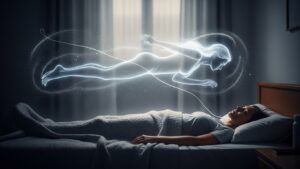
Imagine waking and briefly finding that you cannot move, sensing someone in the room or feeling as though you are looking at your body from somewhere else. Such an experience can be vivid, surprising or frightening. The words used to explain it—“dream”, “sleep paralysis” or “astral travel”—do not necessarily describe the same thing.
When discussing dreams and out-of-body experiences, two questions deserve to be separated: what did the person experience, and what do we know about its cause? Taking the vividness of an experience seriously does not require treating every explanation of it as established knowledge.
This article considers what sleep and bodily perception research can tell us, without assigning diagnoses to people from a distance.
Distinguishing dreams, lucid dreams and sleep paralysis
Dreaming: an experience during sleep
Dreams can include images, emotions, sounds and unfolding narratives. NINDS explains that dreaming can occur in different sleep stages and is usually most vivid during REM sleep. Its precise purpose has not been fully established.
Remembering a dream does not show that every detail occurred in the waking world. The fact that a dream matters to a person also does not require dismissing it as worthless. Personal significance and evidence about the external world are separate questions.
Lucid dreaming: recognising that you are dreaming
In a lucid dream, a person becomes aware that they are dreaming. This awareness does not necessarily give them control over every detail of the dream.
In Konkoly and colleagues’ 2021 study, some participants whose REM sleep was verified through physiological recordings answered researchers’ questions using eye movements or facial muscle signals. This was limited communication under particular laboratory conditions. It did not demonstrate that all dreams can be read or that thoughts are transmitted remotely between minds.
The distinction matters because an interesting finding can become a much larger claim as it is retold. The finding should be assessed according to what the researchers actually measured.
Sleep paralysis: difficulty moving during a sleep transition
Sleep paralysis refers to being unable to move or speak during a transition into or out of sleep. The NHS describes an accompanying sense of presence or pressure in some experiences. Even so, one account is insufficient to assess an individual person.
Our separate article on the scientific explanation of sleep paralysis explores that topic. Grouping different sleep experiences under a single label can obscure important distinctions between them.
What does “out-of-body experience” describe?
The expression describes a person experiencing themselves as located outside their usual bodily position, or seeming to perceive the surroundings from a different viewpoint. Naming that experience does not establish its cause in advance.
An experience within a dream and a change in bodily perception reported while awake should not automatically be treated as identical. Whether a person was asleep, how long the episode lasted and the circumstances in which it occurred all matter.
“I felt as though I had left my body” reports an experience. “My consciousness physically separated from my body and travelled elsewhere” adds a proposed explanation. Assessing the second claim requires evidence beyond the vividness of the first.
What do studies of the brain and bodily perception show?
In 2002, Blanke and colleagues reported experiences resembling an out-of-body experience during electrical stimulation of a particular brain region in a patient being evaluated for epilepsy. This single-patient observation is relevant to investigating links between bodily perception and brain processes. It does not show that all such experiences have the same cause, or that everyone reporting one has epilepsy.
The 2007 study “Video ergo sum” experimentally altered the relationship between visual and bodily sensory information. Participants’ experienced location and identification with a virtual body could be influenced. Research of this kind shows that aspects of bodily self-perception can be investigated experimentally.
The scope of these findings matters. The measurements concern perception, bodily information and reports of experience. The experiments did not demonstrate that consciousness physically travelled to another dimension. Questions that remain unanswered also do not, by themselves, establish one particular metaphysical explanation.
Do similar accounts establish a common explanation?
When two people describe a similar sensation, that resemblance can be a starting point for investigation. Its cause still needs to be examined. Relevant questions could concern sleep stage, bodily sensations, the words used and accounts the person had encountered before the experience.
This does not mean that every account must come from the same source. Closing an open question with a single ready-made story can hide other possibilities.
For example, “I felt as though I was floating upwards” does not reveal the person’s intentions, intelligence or character. Belittling someone who describes an unusual experience does not make an explanation more scientific.
A more informative conversation begins with a careful description. An honest description can remain useful even when the cause has not yet been established.
Separating observations from interpretations
If you want to record an experience, the following headings may help. They are not a diagnostic test or instructions for producing the experience again.
- Was I falling asleep, waking up or awake during the day?
- What sensation do I remember, and how long did it last?
- Could I move and speak?
- What do I directly remember, and what explanation did I add afterwards?
- Did it affect my sleep or daily life?
“I noticed a shadow in the room” and “I know exactly what the shadow was” are different kinds of statements. Keeping them separate in a note may clarify which part can be investigated.
The same care applies to a dream report. Details remembered immediately and interpretations developed later need not be treated as interchangeable.
Our article on dreams, hallucinations and the chosen-one belief also considers the distinction between an experience and the meaning assigned to it.
When might seeking help be useful?
The NHS recommends speaking with a doctor when recurring sleep paralysis causes fear of sleeping or persistent tiredness. Changes in perception that continue while awake or substantially affect everyday life should also be discussed with a health professional, rather than explained solely as dreams.
An assessment needs the context of the person’s experience. This article cannot establish a psychiatric or neurological diagnosis for you or someone else.
A philosophical perspective on respecting an experience
This section offers a reflection on knowledge and experience, not an experimental result. Listening to someone does not require telling them that they never felt what they describe. It also does not require accepting their interpretation as a proven fact about the external world.
Someone might reflect on a person they miss after a dream, notice a question in their life or feel inspired to write. That personal significance is not a document validating every further claim made about the dream.
Curiosity and caution can be maintained together. Describing what we experienced carefully, acknowledging what remains unexplained and respecting the limits of the evidence can all be part of that curiosity.
Frequently asked questions
Does lucid dreaming mean leaving the body?
Lucid dreaming means recognising that you are dreaming. That definition does not include a claim that consciousness has separated from the body.
Do these studies prove astral travel?
The studies discussed here examine sleep, communication signals and bodily perception. They do not demonstrate physical travel to other dimensions.
What if a dream resembles something that happens later?
Resemblance alone does not establish that the future was foreseen. Assessing such a claim would require examining clearly recorded predictions made in advance and conditions for independent evaluation.
Sources
- NINDS. Understanding Sleep (Brain Basics). https://www.ninds.nih.gov/sites/default/files/2025-05/understanding-sleep.pdf
- NHS. Sleep paralysis. https://www.nhs.uk/conditions/sleep-paralysis/
- Konkoly, K. R., et al. (2021). Real-time dialogue between experimenters and dreamers during REM sleep. Current Biology, 31(7), 1417–1427.e6. https://doi.org/10.1016/j.cub.2021.01.026
- Blanke, O., et al. (2002). Stimulating illusory own-body perceptions. Nature, 419, 269–270. https://doi.org/10.1038/419269a
- Video ergo sum: manipulating bodily self-consciousness (2007). Science. https://pubmed.ncbi.nlm.nih.gov/17717189/