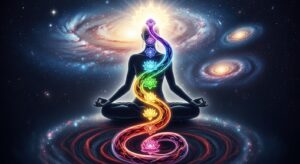
 Within every human being lies a potential yet most of the time, that potential sleeps.
The philosophy of Kundalini is the symbol of that sleeping power.
Some define it as energy, others as a state of consciousness.
But its essence is one and the same: The creative force hidden within one’s own existence.
In ancient Indian thought, the word Kundalini means that which is coiled.
It is not merely an energy stored in the body but a metaphor for the structure of consciousness itself.
For human awareness also functions like a spiral it turns inward, ascends within, and eventually meets itself.
The rise of Kundalini along the spine is the symbolic narration of one’s journey toward self knowledge.
The first center is the instinct to exist; the last is the awareness of existence.
It is a path that moves from instinct to intuition, from material awareness to the consciousness of being.
From a philosophical point of view, the teaching of Kundalini expresses a fundamental law of nature:
“Everything carries potential within itself, but that potential can only unfold through consciousness.”
This idea converges with Aristotle’s concept of entelecheia that within every being resides a form waiting to be realized.
Kundalini, in the language of Eastern philosophy, is the energetic counterpart of that very form.
Thus, to awaken Kundalini is not to awaken a serpent, but to allow consciousness to remember itself.
For what humanity has forgotten is that it was never separate from the universe.
The Western mind often views energy as a physical phenomenon, while the Eastern mind identifies it with consciousness.
The philosophy of Kundalini serves as a bridge between the two: Energy is not merely moving matter it is the vibration of a thinking being.
That is why as Kundalini rises through the body, the mind expands in parallel.
As the mind expands, the sense of I begins to dissolve.
And eventually, the human being no longer perceives themselves as an isolated entity but as an echo of the universe itself.
In philosophical terms, this is a process of self-transcendence.
Nietzsche’s concept of the Übermensch is, in essence, another expression of this same ascent the act of surpassing one’s own nature of turning inner potential into reality.
The philosophy of Kundalini, in its essence, communicates one truth:
“The greatest power a human being holds is the ability to transform oneself.”
It is not one of the yogic rites, it is a shift in awareness.
A remembrance that within every human being still vibrates the very first resonance of the whole cosmos.
Kundalini is the name of that echo.
And once that echo is recognized, silence no longer remains silence.
As a philosopher, to my mind, the philosophy of Kundalini reminds us that the cosmos is not outside us it is within.
The ascent is not upward but inward to the absolute core of awareness.