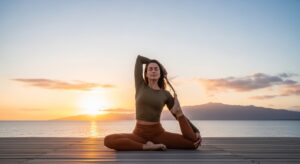
 When someone says yoga, people usually imagine serene settings:
Soft music, peaceful faces, slow breathing…
It gives the impression that if someone practices yoga, they will immediately be in a one with their inner peace state.
Anyway, the truth of the matter is that the experience is much deeper.
Yoga does not soothe everyone.
Actually, for some, it brings tension.
Some get agitated, some lose interest, some simply leave with a ‘This is not for me’ kind of attitude.
At a glance, this looks like a paradox.
Because the general perception of yoga is that of a relaxing activity.
However, yoga is not just about the body work.
Yoga reflects the struggle or harmony a person has internally and with themselves.
And also, it is not a very simple matter for everyone.
People of today are simply estranged from silence.
The world we live in is so engrossing that it barely leaves a room for silence: TVs, computers, mobiles, text messages, music, and so on.
Very infrequently is the mind given the opportunity to be in solitude.
Noise coming from outside is not merely a routine; it is mostly an escape tactic.
Often people make themselves so busy that they never have time to listen to themselves.
Yoga is a halt to that running away.
Doing a few simple moves becomes conscious.
Breathing, which is the basis of the whole thing, is noticed.
Consciousness changes direction.
The mind finds a voice.
Discomfort for some starts from the moment when they realize that in a way they have never done before, they will be hearing themselves throughout their yoga practice.
Hidden thoughts, unexpressed feelings and neglected issues, all burst out in the silence.
Yoga is not meant to be a mind silencer but a mind enlightener.
And honestly, this kind of situation may not be enjoyed by everyone.
Usually, people are used to having the reins.
They plan things, manage, direct, make things happen faster…
The feeling of being in control is equated with safety.
Yoga, on the other hand, is a great teacher.
It teaches how to let go control.
Someone staying in a yoga pose comes to the realization: It is not through exerting force that everything moves forward.
Only when you give them the freedom, do certain things unfold.
Though the ego, favors power movement.
Ego is very much interested in success, recognition, and being acknowledged.
Yoga does not aim at being recognized by others.
Yoga encourages mindfulness.
That is why yoga is not in the ego’s native tongue.
And the ego always feels restless when it finds itself in an unfamiliar place.
There’s yet another aspect: Performance culture.
Most sports quantify success and progress through external factors.
Heavier lifting. Faster running. Longer distances.
Success is something that can be seen.
Yoga breaks the system of how the world measures success.
Because yoga refuses comparison.
Whether you are more flexible or less than the person next to you, it is not a question of achievement.
Doing more difficult poses is not a way to establish the superiority of one over another.
Yoga is not about putting on a show, but it is a spiritual journey.
A person who expects performance from a workout comes to the mat and is probably quite puzzled by yoga’s non-competitive character.
Maybe even displeased.
Because yoga prefers self-awareness to self-approval.
Psychology gives us an important piece of information: The body is the storage of emotions.
Anxiety is not confined to the human brain only; it is reflected in one’s muscles.
Anger, fear, anxiety, all these emotions are in the body and that is why it can literally “hold” them.
Therefore, some people are struck by unexpected feelings when doing certain poses.
Getting emotional in hip-opening poses shedding tears during holding deep stretches can hardly be coincidental.
When the body relaxes, the emotions forbidden to come to light might be revealed.
Yoga not only stretches muscles but also the memories.
And not everyone wants to be exposed like that.
The nervous system is also the entity that gets greatly affected by yoga.
The slow breath and the mindful walk stimulate the parasympathetic nervous system, the one that provides us with a sense of safety and calm.
But here lies a fascinating fact: Some people don’t even know what being calm means.
A person whose nervous system is used to chronically being in stress
may see relaxation as an opening for danger.
Because what is familiar (stress) might be more comforting than what is unfamiliar (peace).
Therefore, it might be the case that yoga brings about discomfort rather than serenity in the beginning.
From a philosophical point of view, yoga is the art of self-discovery.
Ancient philosophical doctrines purported that the greatest Lord’s journey is inward, not outward.
Yoga is among the implements one can choose for that journey.
But there are ways in which people see themselves.
Because self-acknowledgement can imply self renewal.
Yoga escape makes difficult.
It slows your pace.
It unveils.
It put a mirror in front of you.
And not all of them want to glance.
Maybe the discomfort experienced in yoga is not an issue but a signal.
A signal that something is getting noticed.
Change seldom starts in comfort.
We have to see first, then accept, and finally change.
Yoga doesn’t offer peace.
Yoga pledges truthfulness.
And truthfulness frequently precedes peace.
Maybe the fact is that: Yoga doesn’t make you relaxed…
It mainly reveals you to yourself.
When a person really starts to listen inside peace ceases to be a goal
and turns into a natural state.
Yoga does not compel this state.
It merely shows the way.
Going that way
is up to one’s own courage.